Tuesday, April 08, 2008

Meet Michigan's Meanest Man (Bo) [and the players who kept him on his toes]

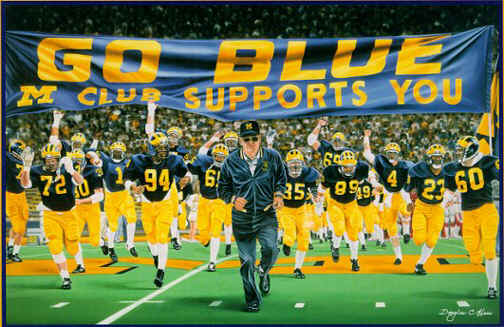
Currently, the fourth most popular article at "The Vault" on SI.com is a piece on Bo and the Michigan Football program from 1970 entitled "Meet Michigan's Meanest Man." The article captures how Bo was tough but was beloved. The article takes note of the role that safety Jim Betts and offensive tackle Dan Dierdorf played as they "tried to keep everyone loose with a running string of gags." In particular, the article highlights the amusing antics of Betts who is also referred to in the piece as the team's best athlete. The funny anecdotes are meant to show that despite Coach Schembechler's all-business reputation, that he let the players have fun and the team was incredibly devoted to him. As Dierdorf explained, "As Bo says, he runs a tough football program. Run and run and run. The track team doesn't run as much as we do. And their coach isn't as mean, either. But this team has a sense of humor. Practice is serious but there is always time for a laugh."

Tough coach. Lots of running. Still time for a laugh. No wonder the 2008 Spring Practice was giving me a sense of deja vu. Go Blue!

*Note: Photo of Bo's pranksters Jim Betts (top left) and Dan Dierdorf (bottom left) with Coach Rich Rodriguez on 2/5/08.

Labels: ,

Wednesday, February 13, 2008

Recruiting: How times have changed

Last week two big events occurred back-to-back at Schembechler Hall. First, on Tuesday, February 5, 2008, thirty players from the 1969 team (Bo's first squad) returned to meet with the current players and coaches. Secondly, on Wednesday, February 6, 2008, Coach Rodriguez announced the incoming class of freshmen as Wednesday was National Letter of Intent signing day. The back-to-back events made me think about how things have changed in the world of recruiting since the days of the 1969 team. One of the players from the '69 team that returned for last Tuesday's event was Michigan legend Jim Betts. According to the book What It Means to be a Wolverine, Betts played high school football in the mid-1960s at Benedictine High in Cleveland, Ohio. His coach was Augie Bossu, a former Notre Dame player. Betts was a QB and was recruited by about 175 colleges during his senior season. However, Coach Bossu did not want Betts to be distracted during the high school season so the coach boxed up all of Betts' recruiting letters and the coach did not give the box to Betts until after the final game of the season. It was only then that Betts learned of all the schools that wanted him to come play for them. Betts' wound up visiting six Big 10 schools but committed to Michigan after a 2-hour home visit by Coach Bump Elliott during which the coach sold Betts' mother on the virtue of a Michigan education.

Contrast Jim Betts' recruitment to that of Ryan Mallett. Mallett was also a top high school QB prospect. However, in 2006, Mallett verbally committed to Michigan while he was still a junior in high school. After playing his senior year of high school football, Mallett graduated just months later and early enrolled as a student at Michigan. In January, 2007, Mallett was a freshman on the Michigan campus while his high school classmates were attending prom and preparing for their regularly scheduled graduation in May, 2007. Back in 1967, when Jim Betts was a freshman, there was a rule that freshmen could not play. That rule was abolished many years ago and Mallett, in 2007, played in 11 games as a freshman. How the times have changed. Go Blue!
*NOTE: Photo of Michigan legend Jim Betts addressing the members of the current team on 2/5/08 from MGoBlue.com.

Labels:

Saturday, February 09, 2008

The past meets the future

There was a cool event that occurred this week on Tuesday, February 5, 2008 that got lost in the shuffle because everyone was focused on February 6th National Signing Day. On Tuesday, the 1969 Michigan Football team came at the invitation of Coach Rodriguez to speak to the current Wolverine football team. The 1969 team was Bo's first team and thirty players from that squad came out to meet with the staff and players of Coach Rodriguez' first team. Returning players included Jim Betts, Dan Dierdorf, Reggie McKenzie, Billy Taylor, Paul Seymour, Jim Brandstatter, and Don Moorhead. The meeting of the 1969 team with the 2008 team was the brainchild of Dana Coin, the kicker from the '69 team. The event was a huge success. Click here for a link to the photo gallery from the event. Go Blue!

*Note 1: Top Photo of Coach Rodriguez addressing members of the 1969 team on February 5, 2008 from MGoBlue.com.
*Note 2: Side Photo of Coach Rodriguez (far right in photo) speaking with Michigan legends Dan Dierdorf (left) and Jim Betts (top) on 2/5/08 from MGoBlue.com.

Labels: ,

Saturday, January 12, 2008

Should Carlos Brown switch to QB?

With the departure of Chad Henne (graduation) and Ryan Mallett (pro-style offense), Michigan has two remaining scholarship quarterbacks (i.e., Steven Threet & David Cone) and a walk-on (i.e., Nick Sheridan). It has been reported that Coach Rodriguez plans to add at least a pair of quarterbacks to the roster although he typically likes to carry five (5) scholarship quarterbacks. In discussions of Michigan's quarterback situation, an interesting name has popped up: Carlos Brown. Brown (So. in 2007) was a dual threat QB in high school. In his senior year at Heard County (Ga.) High School, Brown played both running back and quarterback. He completed 27-of-52 passes for 541 yards and 7 passing touchdowns while running for 1,512 yards and scoring 21 rushing touchdowns on 135 carries.

Brown has worked out at three different positions in two years while at Michigan. Brown came to Michigan as a running back in January, 2006 (as an early enrolee), practiced some at quarterback as a freshman, switched to cornerback in 2007 Spring Practice, almost left the program, and then switched back to running back by the end of Spring Practice after Kevin Grady got hurt and was out for the 2007 season. Brown (who wears jersey #23) is extremely talented but has yet to break out like he had hoped. His situation is eerily reminiscent of that of another supremely talented player who wore #23 for the Wolverines: Jim Betts. Betts arrived to Michigan as a freshman in 1967 back when Bump Elliott was the Head Coach. Back then true freshmen were not allowed to play. Betts had played quarterback in high school at Benedictine High School (Cleveland, OH). Betts practiced as a quarterback in 1967 as a freshman but he was switched to running back in 1968. During the 1968 season, Betts was switched to wide receiver where he wound up catching 4 passes for 29 yards that season. Betts had played 3 positions in his first two seasons at Michigan but he got a new lease on life when a new head coach (Bo Schembechler) took over the team prior to his junior year of 1969. Coach Schembechler promptly switched Betts back to the quarterback spot for his junior season and Betts became a fantastic back-up to starter Don Moorhead.

Michigan's current roster of scholarship quarterbacks (Steven Threet and David Cone) are prototypical drop-back passers. Depending how successful Coach Rodriguez is in recruiting dual threat prep quarterbacks over the next few weeks, switching Brown to QB for his junior season may be a viable option. Brown, like Pat White at WVU, has tremendous speed and the spread offense seems tailor made for Brown's skills. Coach Rodriguez emphasizes that the QB has to be able to make quick reads, hit holes, and throw well. Brown may well decide a switch to QB is in order. The arrival of Coach Rodriguez and the spread offense could give him a new lease on life. Go Blue!
*Note: Top Photo of Carlos Brown (23) from 2006 Media Day by JOHN T. GREILICK/The Detroit News
*Note 2: Bottom Photo of Jim Betts (23) from TK Legacy Michigan Signature Series Card.

Labels: ,

Saturday, June 30, 2007

30-year Flashback: 1977 coaching staff

In 1977, Head Coach Bo Schembechler was entering his ninth season at the helm. Coach Schembechler amassed an impressive 76-7-3 regular season mark in his first eight seasons (1969-1976) as head coach of the Wolverines. Coach Schembechler was coming off another fantastic year as the Wolverines had won the Big Ten title in 1976 and finished 10-2 (7-1 in conf.) with a #3 ranking in both the AP and the UPI polls. Coach Schembechler's teams had won or tied for Big Ten titles six times in his first eight years and the Wolverines had been to three Rose Bowl games in that span including the previous season. The problem was that the Wolverines were 0-3 in those Rose Bowl contests. However, Coach Schembechler believed that 1977 could be different as he had many returning stars from the 1976 team including junior quarterback and Heisman Trophy candidate Rick Leach. However, before he could worry about winning a Rose Bowl, Coach Schembechler first had to get his team through a tough conference schedule and to a second consecutive Big Ten title. Repeating would not be easy because although many key players returned to the team in 1977, an important coach did not. Defensive Coordinator Gary Moeller, the mastermind behind Michigan's tough defense, left the Wolverines to take the Head Coach position at the University of Illinois. Coach Schembechler then promoted Defensive Line coach Bill McCartney to be the new Defensive Coordinator for the 1977 season.

Defensive Coordinator Bill McCartney
Coach McCartney was 36-years old and in his fourth year on staff when he became Defensive Coordinator of the Wolverines in 1977. Coach McCartney served as the Defensive End Coach for his first three years at Michigan. He was a Riverview, MI native having graduated from Riverview Community High School (RCHS). [ed. note: If that sounds familiar that is because that is the same hometown and high school that current Wolverines' Head Coach Lloyd Carr hails from.] Prior to joining the Wolverines' staff in 1974, Coach McCartney had been coaching at Dearborn Divine Child High School where his teams won state titles in both football (1971 & 1973) and basketball (1973).

Offensive Line Jerry Hanlon
Coach Hanlon came to Michigan in 1969 with Coach Schembechler. Coach Hanlon was responsible for coaching the offensive line. He had two All-American candidates in Walt Downing and Mark Donahue to instruct on the 1977 squad. Prior to arriving at Michigan, Coach Hanlon worked as one of Coach Schembechler's assistants at the University of Miami (Ohio).

Offensive Interior Line Paul Schudel
Coach Schudel was a former player and graduate assistant at the University of Miami (Ohio) under Coach Schembechler. Coach Schudel played three years as offensive tackle for Coach Schembechler at Miami and was tri-captain his senior year while also earning All-Academic honors. After graduation in 1966, Schudel went on to work two years as a graduate assistant under Bo at Miami, two years as offensive line coach at New Hampshire, two years as offensive line coach at Colorado State, and two years at William & Mary in the dual role of offensive coordinator/offensive line coach. In 1974, Schudel served as offensive line coach at Syracuse for former Michigan assistant Frank Maloney. While coaching at Michigan in 1976, Schudel helped guide Guard Mark Donahue to achieve All-American honors.

Offensive Ends Tirrel Burton
Coach Burton joined the Michigan staff in 1970 as freshman coach and took over the receivers in 1972. He coached Jim Smith to All-American honors in 1976. Coach Burton, like several of the other Michigan coaches, was from the University of Miami (Ohio) as he had both played and coached at Miami. Coach Burton was an outstanding halfback at Miami, twice being named All-MAC. He averaged 8.8 yards per carry and scored 84 points his senior year which were both records. Coach Burton was also a track star winning his way to the NCAA 220 hurdle finals in 1955. Coach Burton was elected to the Miami Sports Hall of Fame for both football and track. Coach Burton graduated from Miami in 1956 and later obtained his Master's Degree while working as an assistant coach at the school. Even though All-American Jim Smith had moved on, Coach Burton expected that some of his young players such as Ralph Clayton could contribute to the Wolverines' success during the 1977 season.

Offensive Backs Don Nehlen
Coach Nehlen joined the Michigan Football coaching staff in 1977 replacing Chuck Stobart who was named Head Coach at the University of Toledo. Coach Nehlen (who would later go on to be the Head Coach for 21 years [1980-2000] at West Virginia University) joined the Wolverines' staff in 1977 after having served the previous nine seasons as the Head Coach at Bowling Green and having compiled a 53-35-4 record. One of Coach Nehlen's main duties for the 1977 season was to work with quarterback Rick Leach (junior).

Defensive Ends Dennis Brown
Coach Brown was in his fifth season on the Wolverine Football coaching staff in 1977 but his association with the program stretched much further back than that. Coach Brown was the Wolverines' starting quarterback in 1967 and 1968. Brown, a graduate of Lincoln Park High School, became the starting quarterback midway through his junior year. In his first game, he established the Big 10 total offense mark. In 1968, he led the Big 10 in total offense and was named All-Big Ten. Brown spent one season as a graduate assistant to Coach Schembechler in 1970 before heading to Dartmouth for a year as the freshman coach. Coach Brown returned to Michigan to work with the backfield and to serve as varsity-reserve coach. Coach Brown became Defensive Ends coach in the spring of '77 when Coach McCartney was named Defensive Coordinator.

Defensive Backs Jack Harbaugh
Coach Harbaugh came to Michigan in 1973 from Iowa as coach of the defensive backs. He and his wife Jackie have three children: John, Jim, and Joan. The middle child, Jim Harbaugh, served as a ball boy for the Wolverines. In 1977, Coach Harbaugh's star pupils included team co-Captain Dwight Hicks and Melvindale native Mike Jolly (So. from Southgate Aquinas H.S.).

Defensive Coach Tom Reed
The 1977 season was Coach Tom Reed's final year with the Wolverines as he accepted the job as Head Coach at the University of Miami (Ohio) following the season. He was replaced on the Michigan staff in 1978 by Milan Vooletich.

Equipment Manager Jon Falk
Jon Falk, another product of the University of Miami (Ohio), joined the Wolverines in 1974 at the behest of Coach Schembechler. Although only 23 years old at the time, Mr. Falk was named by Coach Schembechler to be the head equipment manager for Michigan. (Mr. Falk would go on a Cal Ripken-like consecutive game streak of 384 games that spanned from 1974-2005). In 1977, Mr. Falk was in his fourth year with the Wolverines and he already had everything down to a science. Well, except maybe for the taking of the team photo. Check out Mr. Falk in the 1977 team photo in the back row, second from right. I don't think he was ready.

Football Academic Counselor Jim Betts
Before there was Shari Acho, there was Jim Betts. In 1977, Michigan football legend Jim Betts (who had played for Coach Schembechler during Bo's first two years as the Wolverines' coach) was in charge of the Football players' academics. This was long before anyone ever dreamed of the Stephen M. Ross Academic Center or the Academic Success Program. Football Academic Counselor Betts was no nonsense in his approach in making sure that Coach Schembechler's players attended class and performed up to expectations.

Go Blue!

*Note: Photo of Coach Bo Schembechler from collection of Bentley Historical Library, U-M
*Note 2: Photo of Jim Betts from TK Legacy Michigan Signature Series card.

Labels: , , ,

Saturday, March 17, 2007

Michigan's backup quarterbacks: Always at the ready

Freshman sensation Ryan Mallett will likely fill the #2 spot on the depth chart for the Wolverines at quarterback in 2007. Being the backup QB is a difficult job for an athlete as the player has to mentally prepare for each game as if he is going to play because he may be called upon to enter the game at anytime in case of an emergency with the starter. The test for the backup QB is to be able to keep himself sharp mentally even though he knows that the chances are great that he might not see a single snap of action in the particular game for which he is preparing. Even when a backup QB is finally inserted into the game, the player is limited by the coaches in what he is supposed to do perform because of the circumstances of the game. Often, the backup QB is just supposed to "run out the clock" and is not supposed to run the full offensive scheme. Thus, even when the backup QB finally sees the field, he is not able to show his true capabilities. Such is the plight of the men who fill the #2 spot on the depth chart at quarterback. As Ryan Mallett toils as the backup QB during his freshman season, he will be following a grand tradition of Wolverine quarterbacks who have filled that slot. Following are some of the more interesting stories of Michigan's backup quarterbacks from the modern era (1969-present):

Jim Betts (1969)
In only his second game as head coach of Michigan, Coach Schembechler's Wolverines hosted Pac-8 conference foe the University of Washington Huskies in Ann Arbor. Michigan opened up a huge 45-7 lead by the fourth quarter and Coach Schembechler pulled the first unit including starting quarterback Don Moorehead. Backup quarterback Jim Betts entered the game and was instructed to run out the clock. However, on an option run/pass play Betts spotted an open Bill Harris streaking down the field and Betts hit him with a perfect strike for a 59-yard gain. The only problem was that Coach Schembechler wanted Betts to run out the clock not run up the score. Coach Schembechler was so infuriated that when Betts returned to the sideline, Coach Schembechler benched the entire second unit for the rest of the game. As legend has it, Reggie McKenzie and the rest of the second unit offensive lineman were mad at Betts because it cost them playing time. This story illustrates part of the plight of the backup quarterback. The player should do well but not to well. If he does, he risks getting in trouble.

Dave Hall (1982)
In 1982, quarterback Steve Smith led the Wolverines to their fifth Rose Bowl game in seven years. Smith led Michigan to an 8-1 Big 10 Conference record and the Big 10 title that season. Backup quarterback Dave Hall saw very limited action during the course of the year as he threw only 14 passes (completing seven). In the second quarter of the 1983 Rose Bowl game versus UCLA, the Wolverines were trailing 7-0 when Smith suffered a separated shoulder while being tackled on an option play that went for eight yards and a first down. Smith's injury forced him to miss the remainder of the game and Coach Schembechler called upon Dave Hall to lead the Wolverines. Hall was thrust into the line-up in front of a national TV audience in "The Granddaddy of Them All" and had the task of guiding the Wolverines to victory over the Bruins. Despite playing reasonably well (13/24, 155 yds., 2 tds., 2 int.), Hall and the Wolverines came up short as Michigan lost the '83 Rose Bowl by the score of 24-14. Hall's story illustrates how a backup quarterback always has to be ready to enter a game (especially the most important game of the season) in case of an emergency.

Chris Zurbrugg & Russ Rein (1984)
Whereas Dave Hall had to step in and assume the quarterback duties on a short-term basis (one game) due to an injury, the backups in 1984 were forced to assume the starter's role for the final seven games of the 1984 season after Jim Harbaugh broke his arm in the Michigan State game. Chris Zurbrugg (63/113, 691 yds., 6 tds., 7 int.) and Russ Rein (17/31, 142 yds., 1 td., 3 int.) split the duties for the rest of the season while leading Michigan to a 3-4 record. It should be noted, however, that Zurbrugg did throw four touchdown passes in the Purdue game that season which tied him for the Michigan record for most touchdown passes thrown in a single game. Nonetheless, 1984 is an example of what can happen if the starter goes down with an injury and there is not a big-time recruit waiting in the wings to fill-in for the rest of the season. Fortunately for Coach Carr, the 2007 team does not have that problem as it has Ryan Mallett waiting in the wings as the #2 quarterback on the depth chart. Go Blue!

*Note: Photo of Jim Betts from TK Legacy Michigan Signature Series card.
*Note 2: Photo of David Hall from TK Legacy Michigan Quarterback Collection card.
*Note 3: Photo of Coach Schembechler and Chris Zurbrugg (12) from dust cover of 1994 book "A Dynasty in Blue: 25 Years of Michigan Football Glory (1969-1994)" edited by Francis Fitzgerald.

Labels:

Saturday, January 27, 2007

Back to the Future for #23

The one area in which Michigan exhibited a talent deficiency in 2006 was in the defensive secondary. With the graduation of All-American cornerback Leon Hall, the situation looks even murkier heading into next season. Additionally, Michigan is likely to have a new defensive secondary coach as Ron Lee, who coached the cornerbacks last season, was let go from the staff. It is unknown whether Defensive Coordinator Ron English, who coached the safeties in 2006, will continue to coach the safeties next season or whether Coach English will turn over the entire secondary to the new coach when same is hired. No matter who coaches the secondary next year, it will be a difficult challenge with the thin talent to be deployed. However, to improve that situation the Wolverines should repeat history.

Although the Wolverines have a lack of talented players in the defensive secondary, they are loaded at running back. Carlos Brown wound up as #4 on the depth chart at running back in 2006 during his true freshman season. Brown was an early enrolee who arrived at Michigan in January of 2006 and he was expected to challenge for serious playing time behind Mike Hart last season. However, a combination of illness and the emergence of true freshman running back Brandon Minor severly limited Brown's playing time. At the Monday press conference during the week of the 2006 Ball State game, Coach Carr was asked about putting Brown in at running back and Coach Carr responded: "I'm disappointed that we haven't had an opportunity to get him some playing time. I'm disappointed in that, and hopefully that will come because he is a guy with a lot of ability. Sometimes the season just doesn't work out like you want it to." On the season, Brown only carried the ball 16 times for 41 yards. The number of carries for Brown is not likely to increase much next year as Mike Hart, Kevin Grady and Brandon Minor all return at running back in 2007. However, Brown is way too talented to just leave buried on the depth chart at running back.

Carlos Brown is acknowledged as being incredibly fast (second on the team only to Morgan Trent) and athletic. He arrived at Michigan after having played both ways in high school at Heard County (Ga.) High School. In high school, he played both cornerback and free safety and amassed 203 tackles, 11 forced fumbles, 11 interceptions, 4 fumble recoveries and 25 pass break-ups during his prep career. A switch to defense at Michigan for Brown (who wears jersey #23) would be beneficial both to Brown and the Wolverines. It gets Brown on the field as a starter, which he likes, and it fills a glaring hole for the Wolverines which will please Coach Carr.

A move by Brown (#23) from the offensive bench to a starting spot in the defensive secondary is reminiscent of a successful move made by Michigan legend Jim Betts (#23) during Coach Schembechler's second year as Head Coach of the Wolverines. As legend has it, Betts and defensive secondary coach Dick Hunter talked about having the incredibly athletic Betts come over to the defensive secondary which had been decimated by graduation after the 1969 season. The problem was that Coach Schembechler had to be convinced first. Betts, who was the Wolverines' backup QB to Don Moorehead, marched into Bo's office and told Bo that he was switching over to the defense for his senior season. Nobody told Bo what he was going to do and he decided that Betts would play both positions. That was fine with Betts. He won the Meyer Morton Award in 1970 given to the player who exhibited the most promise and improvement as a result of annual spring practice. He started every game of the 1970 season at safety and amassed 45 tackles, 4 pass break-ups, 2 interceptions and 2 fumble recoveries for the 9-1 Wolverines. He played his best game of the year during the year's biggest game as he tallied 14 tackles and an interception in the Ohio State contest.

Carlos Brown should do as his number-sake (#23) Jim Betts did before him and switch to the defensive side of the ball where he can star for the Wolverines next season. Go Blue!

*Note: Photo of Carlos Brown from 2006 Michigan Football Media Day by John T. Greilick/The Detroit News.
*Note 2: You can learn more about Michigan legend Jim Betts from, but not limited to, the following books: Tales from Michigan Stadium by Jim Brandstatter (2002); Michigan: Where Have You Gone? by Jim Cnockaert (2004); What it Means to be a Wolverine by Kevin Allen (2005); Photo of Jim Betts from TK Legacy Michigan Signature Series card.
*Note 3: Special order a #23 jersey from the M-Den to wear at The Big House while Carlos Brown plays defense (maybe) in 2007.

Labels: ,

Wednesday, May 24, 2006

1970: The team that history forgot


Everyone remembers Bo's first team in 1969. The 24-12 win over Ohio State that year in Ann Arbor is widely considered to be one of, if not THE, greatest victory in the history of Michigan football. Bo went on to win 5 Big Ten Championships from 1969-1974. The only team that did not win a Big Ten Championship in that span was the 1970 squad. Thus, they are not as celebrated as the other teams of Bo's early years. However, when you look back, you'll see not only that the 1970 team was one of Bo's best squads in his entire 21 years but that they also came close to winning a National Championship. Yet, you rarely hear about them. Until now.

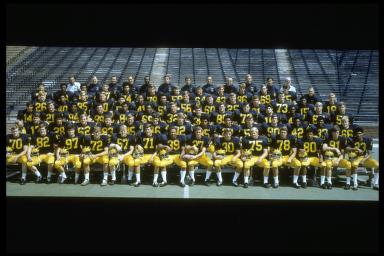
The 1970 team featured Billy Taylor at Halfback, Reggie McKenzie, Dan Dierdorf and Jim Brandstatter on the Offensive Line, Marty Huff at Linbacker, Henry Hill at Middle Guard and Jim Betts and Thom Darden at Safety to name a few. The team blew through their schedule and were 9-0 and ranked #4 in the nation heading into the final game of the season in Columbus against Woody Hayes' #5 ranked Buckeyes. A then stadium-record crowd of 87,331 were at the "Horseshoe" cheering for revenge against the Wolverines for what U of M had done to OSU the year before in A2 in the inaugural Bo/Woody matchup. In 1970, the winner of this game was going to Pasadena as the Big 10 Champion. It was a tough, physical ballgame and the teams were tied 3-3 late in the first half. In the 4th quarter, OSU scored 10 pts. to ultimately pull out a 20-9 victory and end U of M's season at 9-1. The Wolverines finished the year ranked #9 in the AP season ending poll.

The accomplishments of the 1970 team are often overshadowed by the titles won by Bo's other early teams. Nevertheless, the 1970 squad was a great team and should not be forgotten. Even though we did not win the 1970 Ohio State game (and thus don't talk much about it), the game was a classic. It serves as a reminder to me about what a difference a game, or even a half, can make. U-M was SO close to going to the Rose Bowl as an undefeated team and possibly playing for the National Championship. Instead, the 1970 team is hardly recognized for what it achieved. People prefer to reminisce about 1969 or 1971 (which was one of Bo's all-time best teams and will be the subject of another post on a different day) but I don't think fans should forget 1970. That was a great season. Go Blue!

Labels: ,